

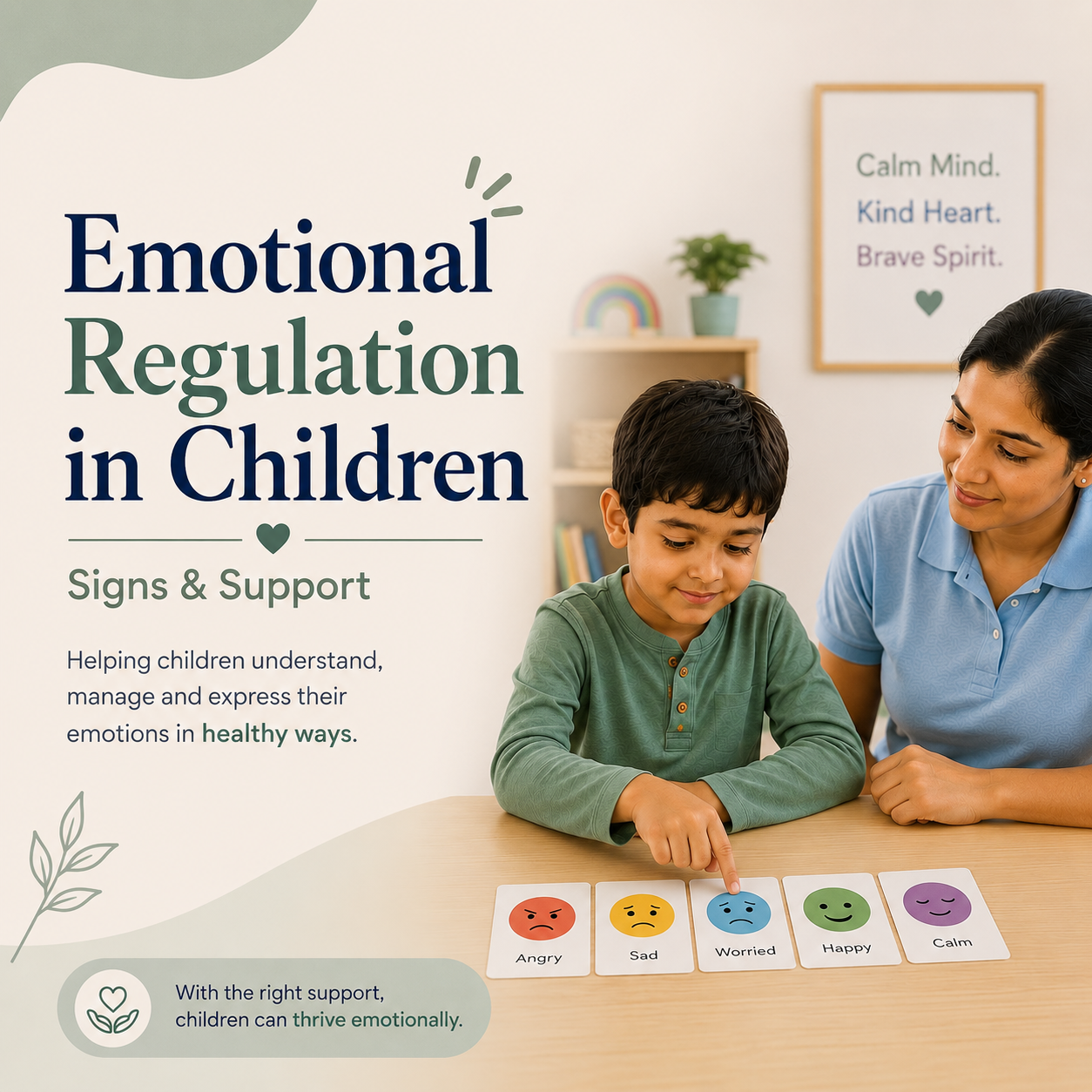
Every child experiences big emotions. Excitement, disappointment, frustration, fear, anger, and sadness are all normal parts of growing up. The challenge is learning what to do with those emotions. Emotional Regulation in Children develops gradually as children learn to recognize feelings, communicate them, calm themselves, and respond appropriately to different situations.
Some children develop these skills naturally through everyday experiences, while others need more direct teaching and support. A child who has frequent emotional outbursts, becomes overwhelmed by small changes, or finds it extremely difficult to calm down may not simply be “throwing a tantrum.” They may still be developing the skills needed to manage their emotions.
Understanding this difference can completely change how parents respond.
What Is Emotional Regulation?
Emotional regulation is the ability to recognize, understand, and manage emotional responses.
It does not mean that children should never feel angry, upset, excited, or disappointed.
Instead, regulation helps children learn:
“I am angry, but I can express it safely.”
“I am disappointed, but I can recover.”
“This situation is overwhelming, so I can ask for help.”
These abilities develop gradually.
Young children rely heavily on adults to help them regulate. As they grow, they increasingly learn strategies they can use independently.
What Can Emotional Regulation Difficulties Look Like?
Children may demonstrate difficulties in many different ways.
Parents may notice:
- Frequent intense meltdowns
- Difficulty calming after becoming upset
- Strong reactions to small disappointments
- Difficulty waiting
- Screaming or crying when frustrated
- Difficulty transitioning between activities
- Running away from overwhelming situations
- Difficulty communicating feelings
- Becoming overwhelmed in busy environments
It is important to look at the pattern rather than one isolated incident.
Every child will occasionally have a difficult day. Persistent challenges that interfere with school, family life, friendships, or daily routines may deserve closer attention.
Why Do Some Children Struggle With Regulation?
Emotional regulation can be influenced by many factors.
Children may have difficulty regulating emotions when they experience:
- Sensory sensitivities
- Communication difficulties
- Attention challenges
- Difficulty understanding social situations
- Anxiety
- Developmental differences
- Difficulty coping with unexpected changes
- Limited emotional vocabulary
For example, imagine a child who cannot explain that the classroom is too noisy.
Instead of saying, “The noise is overwhelming me,” the child may cover their ears, cry, or leave the room.
The behaviour is communicating a need.
Understanding what is happening underneath the behaviour can help adults respond more effectively.
How Therapy Can Support Emotional Regulation
At Belief Shaping Therapies, emotional development can be supported through a multidisciplinary approach involving Occupational Therapy, Speech Therapy, and ABA Therapy where appropriate to the child’s individual needs.
Occupational Therapy may support sensory regulation, body awareness, coping strategies, and participation in daily activities.
Speech Therapy can help children develop the communication skills needed to identify feelings, express needs, understand language, and participate in social interactions.
ABA Therapy may help children learn specific functional skills, communication strategies, coping behaviours, and appropriate responses through structured teaching and individualized goals.
The approach should always be tailored to the individual child rather than assuming that one strategy will work for everyone.
Helping Children Identify Their Emotions
A child cannot always regulate an emotion they cannot identify.
Parents can begin by giving emotions simple names.
“You look frustrated.”
“That was disappointing.”
“You seem excited.”
“You look worried.”
This helps children gradually connect physical sensations and experiences with emotional vocabulary.
Books and pictures can also be useful.
Parents can pause during a story and ask:
“How do you think she feels?”
“What made him sad?”
“What could he do?”
The goal is to make talking about emotions a normal part of everyday life.
Create a Calm-Down Routine
Children benefit from knowing what they can do when they feel overwhelmed.
A simple calm-down routine could include:
- Move to a quiet space.
- Take a few slow breaths.
- Ask for help.
- Use a favourite calming activity.
- Return to the activity when ready.
The exact strategy will vary from child to child.
Some children may benefit from movement, while others may prefer quiet activities. Understanding the child’s individual sensory needs can make these strategies more effective.
What Parents Should Avoid
When a child is experiencing an intense emotional reaction, giving a long lecture is unlikely to help in that moment.
Instead, keep communication simple.
Rather than:
“How many times have I told you that you cannot behave like this? You need to learn to control yourself.”
Try:
“I can see you’re upset. Let’s calm down first.”
Once the child is regulated, the situation can be discussed.
This teaches children that emotions are acceptable while unsafe or inappropriate behaviours can still have boundaries.
Regulation Is a Skill, Not a Switch
One of the most important things parents can remember is that emotional regulation develops over time.
A child who has one successful calm-down experience may still struggle the next day.
That does not mean the strategy failed.
Children need repetition, consistency, modelling, and opportunities to practise these skills across different situations.
Progress may look like:
- A shorter meltdown
- Asking for help instead of screaming
- Recovering more quickly
- Identifying an emotion
- Moving to a calm space independently
- Accepting a small change in routine
These are meaningful developmental achievements.
At Belief Shaping Therapies, our multidisciplinary team works with children and families to develop practical skills that support communication, emotional regulation, participation, and independence.
The goal is not to eliminate big emotions. Children will always experience them.
The goal is to help children understand those emotions, communicate their needs, recover from difficult moments, and gradually develop the tools to navigate everyday situations with greater confidence.
With patient guidance and individualized support, emotional regulation can become a skill children continue strengthening throughout their development.