

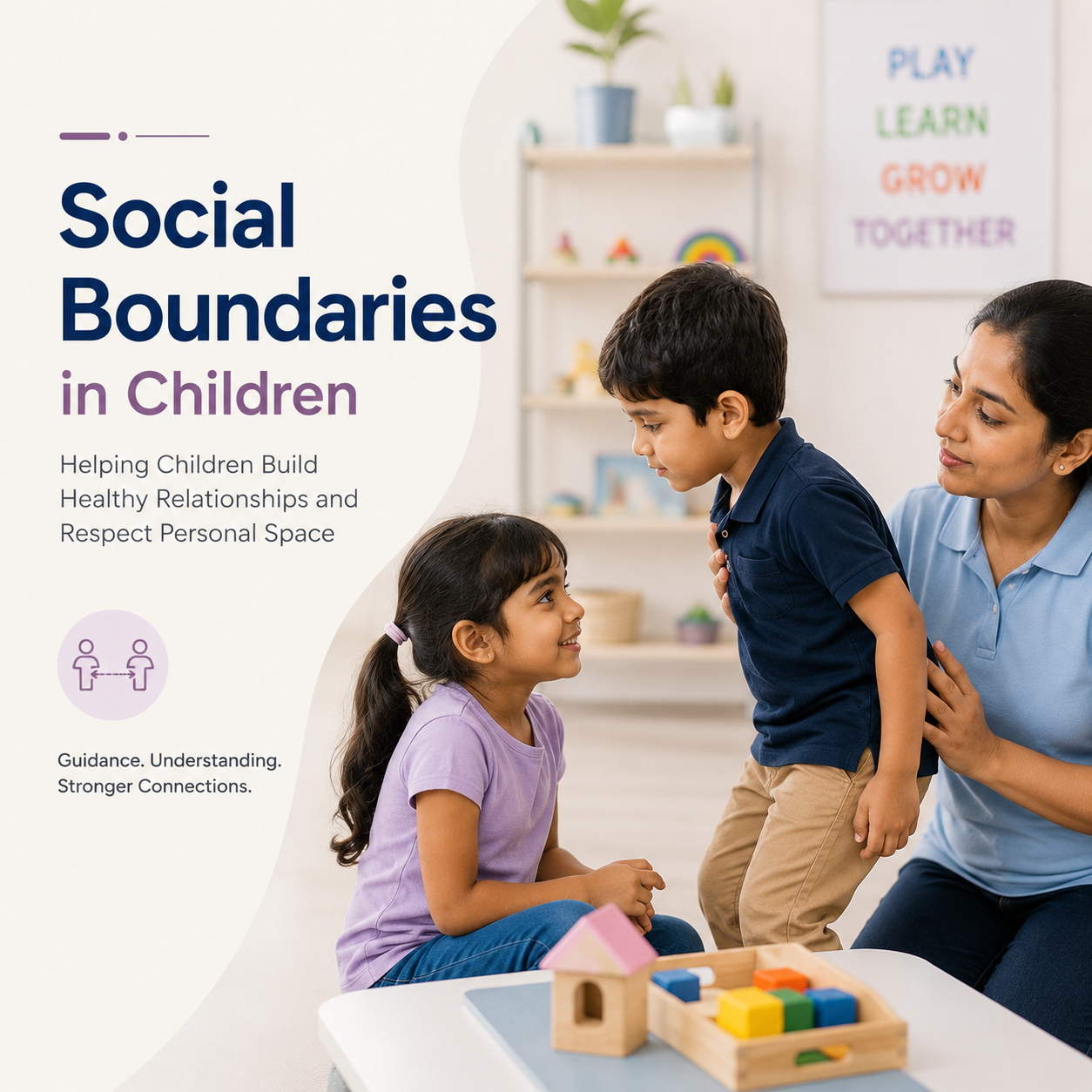
As children grow, they learn many important life skills such as talking, sharing, listening, and making friends. One skill that often receives less attention but plays a major role in everyday life is understanding Social Boundaries in Children. Social boundaries help children recognize personal space, respect other people’s feelings, understand appropriate behavior, and build healthy, meaningful relationships.
Social boundaries are a fundamental part of social and emotional development. They help children understand how to interact respectfully with family members, classmates, teachers, and friends in different environments. Learning these skills early enables children to communicate effectively, develop empathy, resolve conflicts peacefully, and participate confidently in school, community, and family settings.
While some children naturally develop these skills through observation and experience, others may require additional support due to communication challenges, sensory processing differences, developmental delays, Autism Spectrum Disorder (ASD), Attention Deficit Hyperactivity Disorder (ADHD), or difficulties understanding social cues.
Many parents notice behaviors such as standing too close while talking, hugging strangers without permission, interrupting conversations, touching other people’s belongings without asking, speaking loudly in quiet places, or finding it difficult to understand when someone feels uncomfortable. These behaviors are usually not intentional or a sign of poor manners. Instead, they may reflect challenges in understanding social expectations, emotional awareness, or non-verbal communication.
The good news is that social boundaries can be taught and strengthened over time. With structured guidance, evidence-based therapy, positive reinforcement, and consistent practice at home and school, children can develop the confidence and awareness needed to build meaningful friendships, participate appropriately in social situations, and become more independent.
Why Are Social Boundaries Important for Child Development?
Social boundaries are the invisible rules that help people interact respectfully and comfortably with one another. They teach children how to understand personal space, communicate appropriately, recognize emotions, interpret facial expressions, and behave differently depending on the situation.
Developing healthy social boundaries is closely linked to emotional intelligence, communication skills, self-regulation, and successful peer relationships. Children who understand these social expectations often adapt more easily to new environments and feel more confident during everyday interactions.
Children who understand social boundaries are often able to:
- Build stronger friendships
- Participate confidently in school activities
- Respect personal space
- Develop empathy
- Understand emotions
- Communicate more effectively
- Solve conflicts calmly
- Feel comfortable in social settings
- Develop healthy self-confidence and independence.
- Work cooperatively during classroom and group activities.
- Recognize appropriate behaviour in different social situations.
- Build trust and positive relationships with adults and peers.
These important life skills continue to benefit children throughout adolescence and adulthood by supporting academic success, workplace relationships, emotional well-being, and independent living.
For children who experience developmental challenges, learning social boundaries may require more direct teaching, visual supports, structured practice, and repeated opportunities to apply these skills in real-life situations.
What Are Social Boundaries?
Social boundaries include many everyday behaviours that adults often take for granted. They involve understanding both spoken and unspoken social rules that help interactions feel comfortable and respectful.
For example:
- Knowing how close to stand while talking
- Waiting for someone to finish speaking
- Asking permission before touching another person’s belongings
- Understanding when someone wants personal space
- Recognizing facial expressions and body language
- Taking turns during conversations
- Respecting physical boundaries
- Understanding appropriate greetings
- Using an appropriate tone of voice in different environments.
- Understanding when humour or certain topics may not be appropriate.
- Learning when to start, continue, or end a conversation politely.
- Respecting privacy and understanding personal information boundaries.
Children gradually learn these skills through observation, everyday experiences, role modelling, and guidance from parents, teachers, and caregivers.
Some children naturally develop these social skills, while others benefit from explicit teaching, visual demonstrations, role-playing activities, and therapist-guided practice.
Why Do Some Children Struggle with Social Boundaries?
Every child develops social understanding differently. Some children find it difficult to interpret social information because they process communication differently.
Some common reasons include:
1. Communication Difficulties
Children with speech and language delays may struggle to understand conversations, recognize conversational rules, or interpret non-verbal communication, making social interactions more challenging.
2. Autism Spectrum Disorder (ASD)
Children with Autism Spectrum Disorder may find it difficult to understand social expectations, personal space, facial expressions, body language, or the perspectives of others. These challenges can affect friendships and everyday interactions, but individualized therapy can significantly improve social communication skills.
3. ADHD
Children with Attention Deficit Hyperactivity Disorder (ADHD) may interrupt conversations, act impulsively, or struggle with turn-taking due to difficulties with attention, self-control, and executive functioning rather than intentional behaviour.
4. Sensory Processing Difficulties
Some children seek additional sensory input by standing close to others or touching objects, while others avoid physical contact altogether because sensory experiences feel overwhelming.
5. Limited Social Experience
Children who have had fewer opportunities to interact with peers may simply need more guided practice to develop appropriate social behaviours and confidence.
Signs Your Child May Need Support
Every child develops differently, but certain behaviours may suggest that social skill development requires additional attention.
Parents may notice that their child:
- Frequently interrupts conversations
- Talks only about their own interests
- Finds it difficult to wait for their turn
- Stands very close to people while speaking
- Hugs unfamiliar people unexpectedly
- Invades personal space without realizing it
- Struggles to understand facial expressions
- Has difficulty making or maintaining friendships
- Becomes frustrated during group play
- Misunderstands social situations
- Has difficulty understanding jokes, sarcasm, or figurative language.
- Finds it challenging to recognise when others are uncomfortable or upset.
- Avoids cooperative games or struggles to participate appropriately in group activities.
- Has trouble understanding classroom rules or expected behaviour in public settings.
These behaviours do not mean a child is being rude, disrespectful, or intentionally disobedient.
In many cases, the child simply has not yet developed the social awareness needed to interpret verbal and non-verbal communication effectively.
How Therapy Helps Children Learn Social Boundaries
Children learn best when social skills are taught in a structured, positive, and engaging way. Therapy provides repeated opportunities to practice social situations in a safe environment where children can gradually build confidence.
At Belief Shaping Therapies, therapy programs are individualized according to each child’s strengths, challenges, and developmental goals.
Therapy may focus on:
- Improving communication skills
- Understanding personal space
- Recognizing emotions
- Learning appropriate greetings
- Building conversational skills
- Developing empathy
- Improving emotional regulation
- Strengthening peer interaction
- Practising role-play for real-life social situations.
- Learning turn-taking and cooperative play.
- Understanding facial expressions and body language.
- Developing flexible thinking during social interactions.
How Occupational Therapy, Speech Therapy and ABA Therapy Support Social Skills
Our multidisciplinary team works together to improve every aspect of social participation.
Occupational Therapy
Occupational Therapy helps children improve sensory regulation, emotional control, attention, and functional participation. When children feel calm and regulated, they are better able to understand social expectations and participate confidently.
Speech Therapy
Speech Therapy develops expressive language, receptive language, conversation skills, social communication, listening skills, and understanding of non-verbal communication.
ABA Therapy
Applied Behavior Analysis (ABA) Therapy uses structured, evidence-based teaching strategies to help children learn appropriate social behaviours, improve communication, strengthen emotional regulation, and generalize these skills across home, school, and community environments.
How Parents Can Encourage Healthy Social Boundaries at Home
Parents play a vital role in teaching appropriate social behaviour through everyday interactions.
Some practical strategies include:
- Model respectful communication
- Practice turn-taking during conversations
- Teach children to ask permission before touching belongings
- Read books about emotions and friendships
- Role-play different social situations
- Praise appropriate social behaviour
- Encourage group games
- Discuss personal space using simple language
- Use visual cues or social stories to explain expected behaviours.
- Practice greetings and conversations during daily routines.
- Encourage empathy by asking children how others may be feeling.
- Celebrate small improvements to build confidence and motivation.
Consistency, patience, and positive reinforcement help children understand that social boundaries are skills that can be learned over time.
When Should Parents Seek Professional Guidance?
It may be helpful to consult a professional if your child:
- Consistently struggles to make friends
- Frequently invades personal space
- Becomes distressed during social interaction
- Has difficulty understanding emotions
- Shows repetitive social challenges despite guidance
- Experiences communication delays
- Has been diagnosed with Autism or ADHD and needs additional social skill support
- Frequently misunderstands social situations at school or home.
- Avoids interacting with peers due to anxiety or confusion.
- Shows ongoing difficulty following social rules despite consistent teaching.
Early intervention allows therapists to identify the underlying causes of social challenges and provide individualized strategies that improve communication, confidence, emotional regulation, and relationship-building skills before these difficulties begin affecting academic performance and self-esteem.
Building Confident and Respectful Social Skills
Social boundaries are not about teaching children to follow rigid rules or suppress their personality. They are about helping children feel confident, comfortable, and successful in everyday interactions while respecting themselves and others.
When children understand personal space, communication, empathy, emotional awareness, and appropriate social behaviour, they develop stronger friendships, better classroom participation, improved emotional regulation, and greater independence.
At Belief Shaping Therapies, our experienced multidisciplinary team provides individualized Occupational Therapy, Speech Therapy, and ABA Therapy to help children strengthen social communication, emotional regulation, executive functioning, and everyday interaction skills. Through structured, evidence-based interventions and family-centered support, we help children build the confidence they need to connect with others and thrive in every stage of life.
Our goal is to empower every child with practical social skills that can be successfully applied at home, in school, and within the community. By working closely with parents and caregivers, we ensure that learning continues beyond therapy sessions, creating lasting improvements in confidence, communication, and independence.
As children grow, these social skills become lifelong strengths that support academic achievement, healthy relationships, emotional well-being, problem-solving abilities, and independent living. With the right guidance, individualized therapy, and early intervention, every child has the opportunity to develop meaningful social connections, navigate everyday interactions confidently, and reach their fullest potential.